
Evenings in the French Quarter
The French Quarter is not short on obvious pictures. Point a camera in almost any direction and something will try to look important. Ironwork, old brick, gas lamps, balconies, music, doors with ten coats of paint, and the occasional street scene that seems to come pre-composed. Very considerate of the city.
I was in New Orleans on a business trip, which meant my time with the camera came in small evening pieces. No long, leisurely schedule. No full-day wandering with a heroic amount of caffeine and questionable footwear. Just enough time after work to get out, walk the French Quarter, and see what held together in the frame.
The Quarter is New Orleans’ oldest neighborhood, founded by the French in 1718 and still known by its older name, the Vieux Carré. The original grid, the central square, the church, the old street names, and the layered architecture are all part of the experience. It’s crazy how much history sits inside just a few blocks.
Jackson Square and the Old Center of the Quarter
Jackson Square is the visual anchor for the city. St. Louis Cathedral rises behind the square with a symmetry that looks almost too clean. The cathedral’s site has been tied to worship and civic gathering since the city’s founding, with an early church in place by 1722 and later structures shaped by fire, rebuilding, and expansion. The present cathedral includes elements of earlier churches and was expanded and restored in the nineteenth century.
The building is more than a pretty backdrop. It is part of how the French Quarter explains itself. The square, cathedral, and Cabildo and Presbytère, standing on each side of the cathedral, form a tight civic and religious center where New Orleans history is not tucked away in a brochure. The Cabildo, built under Spanish rule between 1795 and 1799, later became the site of the Louisiana Purchase transfer ceremonies in 1803. Now that history usually has someone nearby selling art, playing music, or asking if you want your future read.
The cathedral image is a classic tourist shot. I did have a little luck when the light rain from earlier in the day made way for a slightly dramatic sky at sunset. I kept the cathedral centered to keep the overall symmetry of the scene.
Architecture You Understand Best on Foot
The French Quarter’s architecture is a mix of French, Spanish, Creole, and American influences. On the street it shows up as plastered brick, walled courtyards, arched fanlights, iron balconies, narrow passages, old shutters, and buildings that have been repaired, repainted, and kept in use across generations.
The neighborhood has been reshaped by major fires in 1788 and 1794, and many of the features people now associate with the Quarter came from the Spanish period and the rebuilding that followed. The Vieux Carré Commission was established in 1936 to preserve the historic character of the streetscapes, which is one reason the Quarter still has such a strong architectural identity.
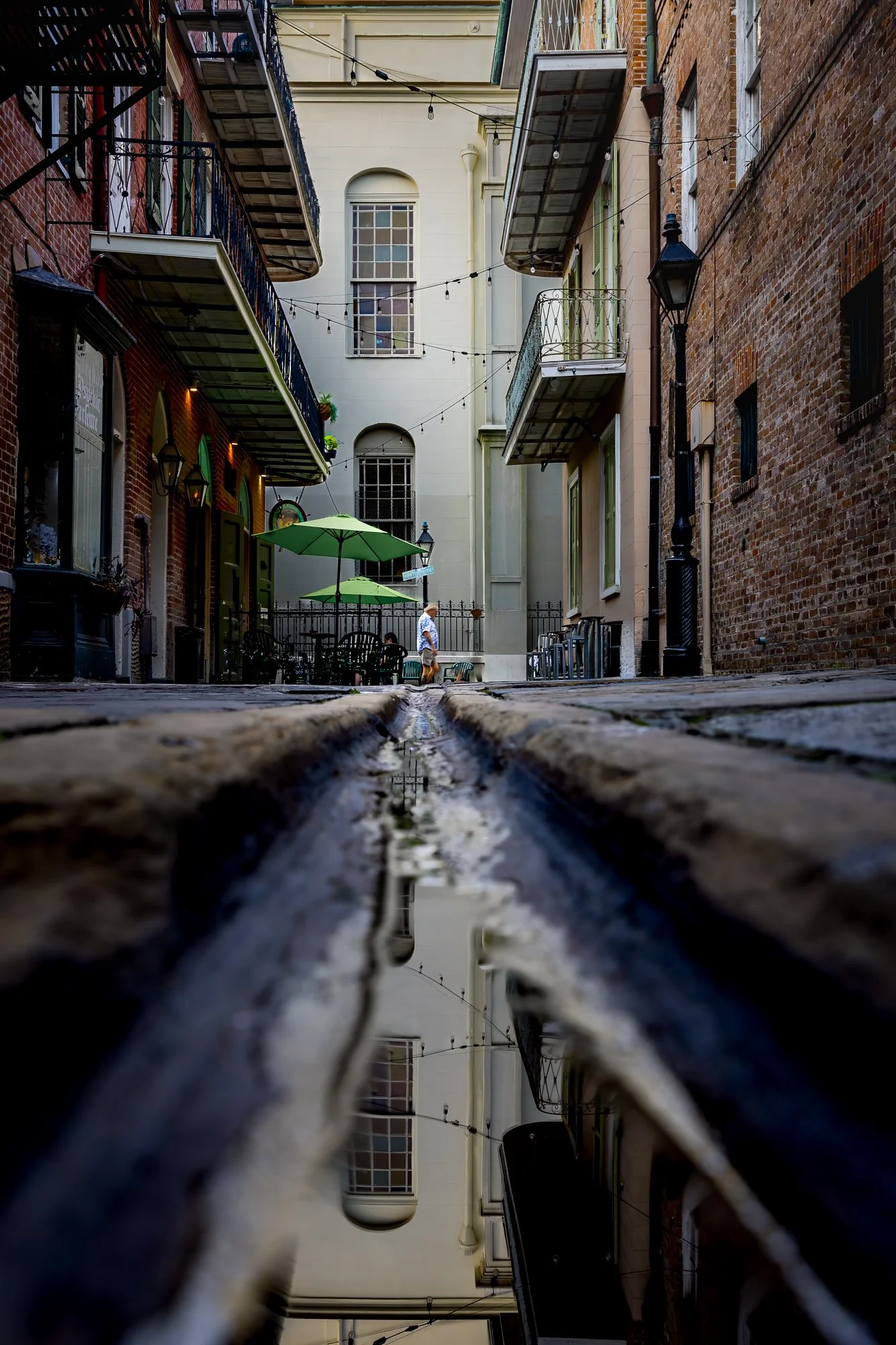
That identity shows up best in the smaller photographs. The low view down Cabildo Alley uses the line of the central gutter as a guide through the frame. The reflection at the bottom gives the scene another layer without making it too neat.
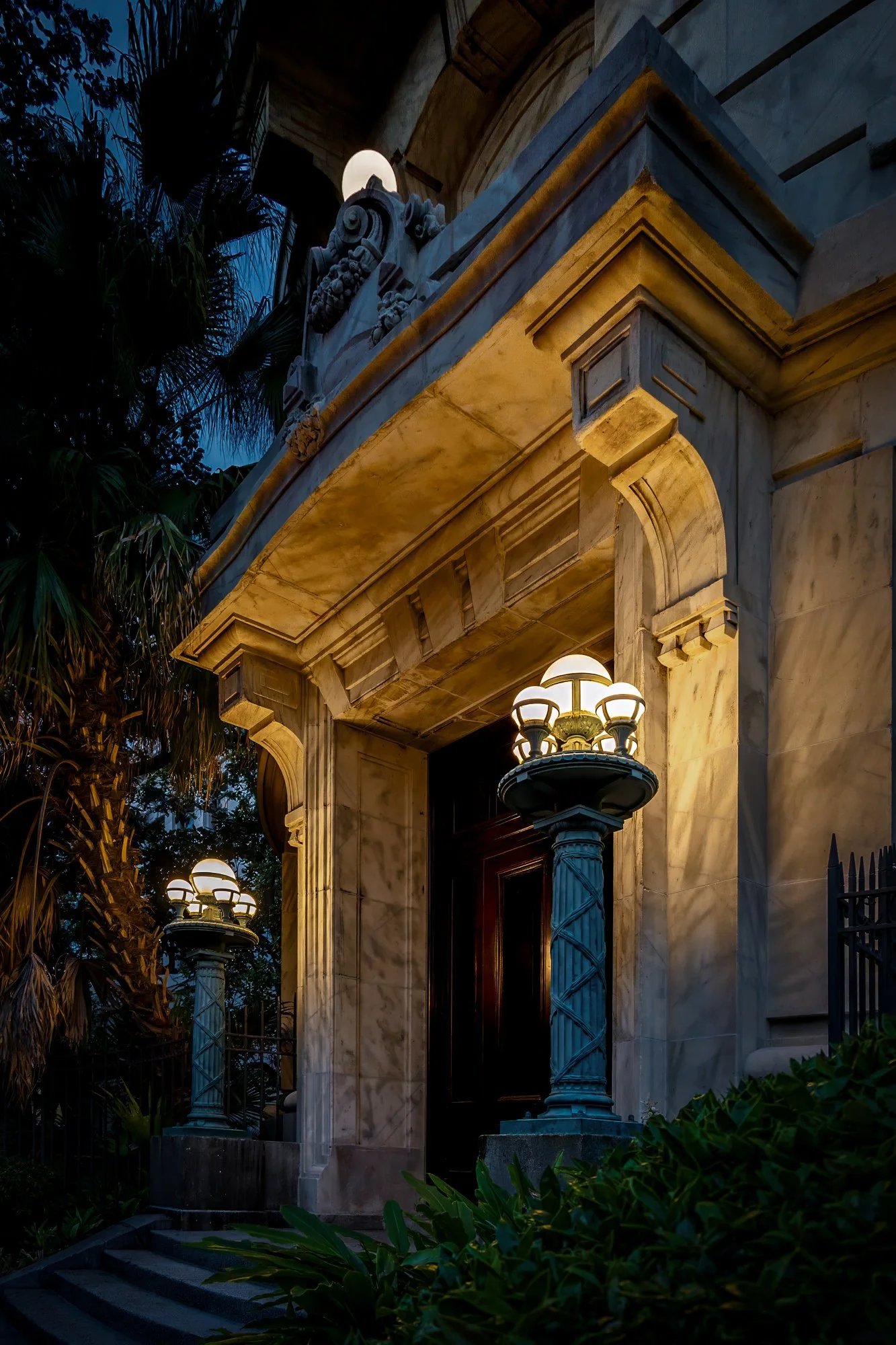
I happened upon the entrance to the Louisiana Supreme Court building at the height of blue hour. I was drawn to the contrast between the architectural weight of the entrance and the soft, warm light on the stone. It is the kind of scene you can miss if your timing is off just a little.
Music in the Walls, and Sometimes in the Street
Preservation Hall is one of the places where New Orleans’ musical history becomes physically small. The venue at 726 St. Peter Street began with Larry Borenstein’s Associated Artists gallery in the 1950s, where traditional New Orleans jazz musicians were invited to play informal sessions. Allan and Sandra Jaffe became involved around 1960, and the hall developed into a place dedicated to preserving and presenting traditional New Orleans jazz.
The weathered shutters, worn sign, ironwork, and patched surfaces of Preservation Hall carry visual weight. Both the broader street-facing scene and the tighter view of the sign tell a different part of the story. The tighter frame gives location and context. The wider frame lends more history and does more storytelling.
A brass-band led parade brings a different kind of energy to the neighborhood. Called Second Lines, these parades have deep roots in New Orleans’ African-American neighborhood traditions, including social aid and pleasure clubs, jazz funerals, weddings, and community processions. The First Line is the band, in this case KINFOLK, leaders, and honored participants. The Second Line is the group of revelers that follows behind, dancing and moving with the music. This is public life, photographed directly, without turning anyone into a prop.
Windows, Doorways, and the Smaller Evening Scenes
Not every photograph from the Quarter needs a famous name attached to it. Some of my favorite captures came from random windows and doorways in the Quarter.
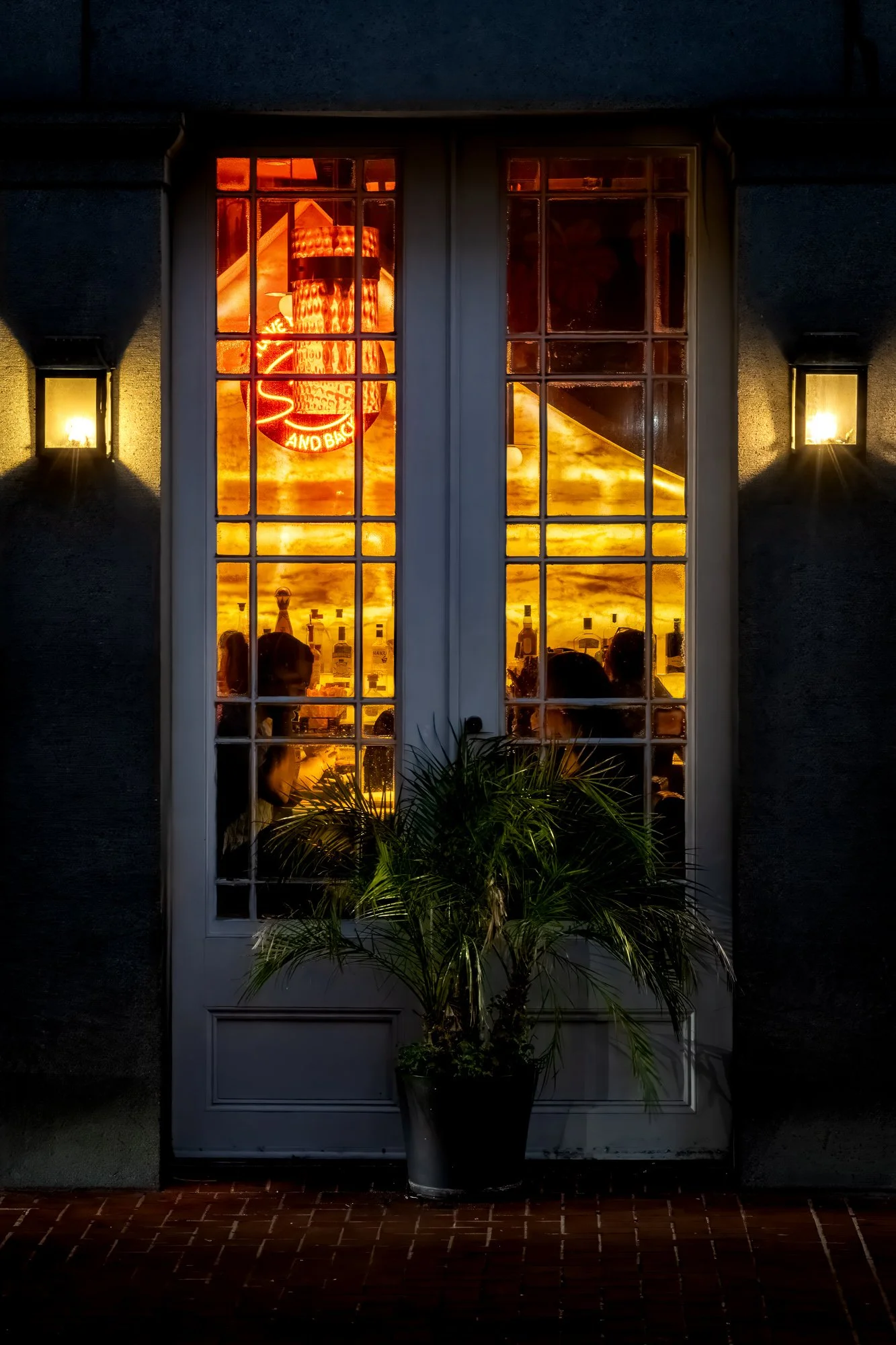
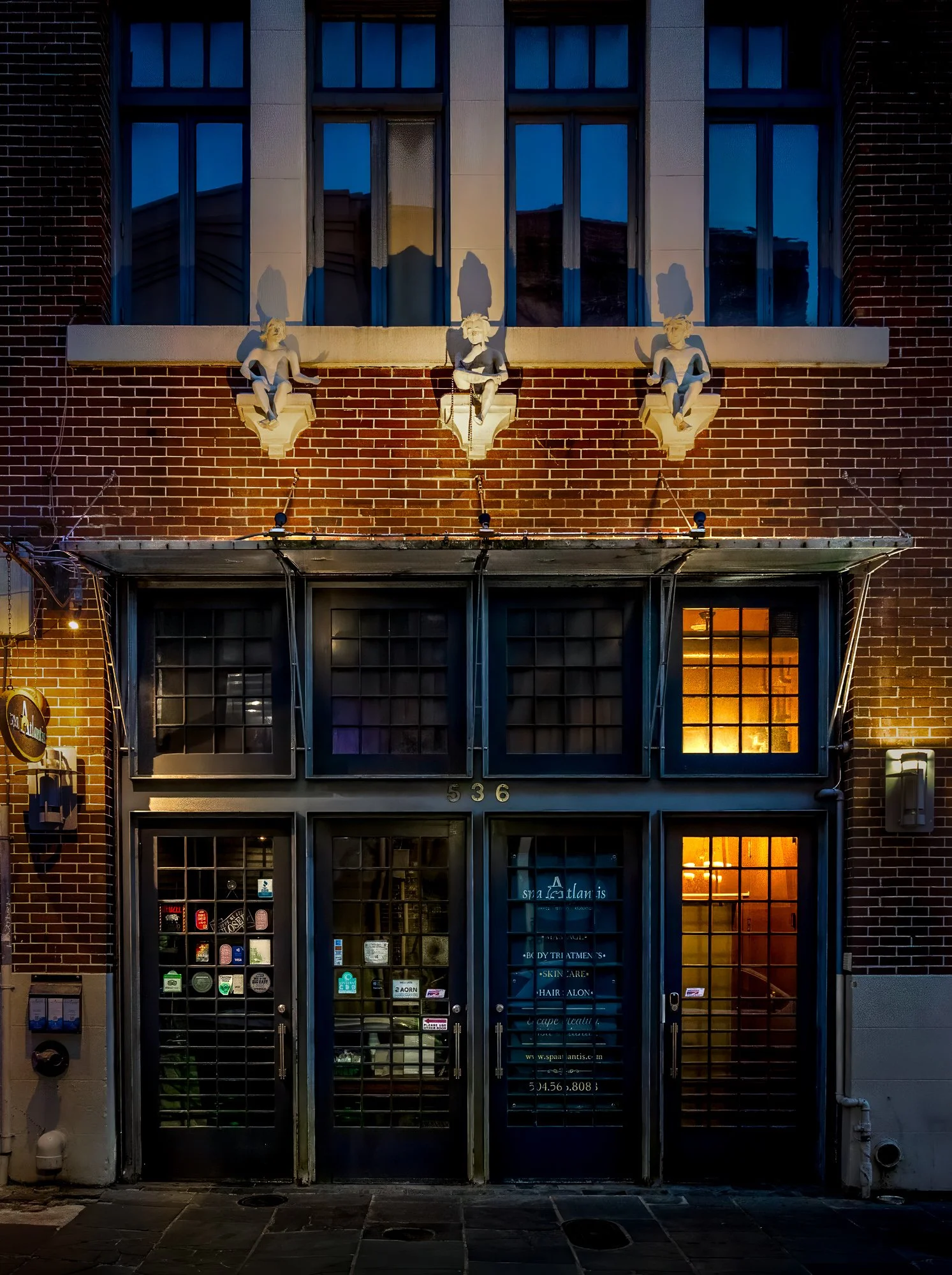
The warm glow through a restaurant window, boxed in by dark exterior walls. A plant at the bottom anchors the frame, while the interior lighting casts the diners in silhouette. The storefront continues that same idea. Windows, lamps, brick, and signage become the subject. These are not grand postcard views. They are the details that make the Quarter more interesting.
The Hotel de la Poste photograph is built around contrast. The green and white lanterns at the top are bright, and immediately draw the attention. Below that the frame drops into shadow, with two people sharing a moment in the courtyard beyond. That separation creates depth and interest.
The Mahogany Jazz Hall gave me my favorite image of the trip. Facing the building directly lets the geometry carry the frame. The vertical lines of the windows and doors, the repeated arches, and the hard curb line at the bottom give the photograph structure. The straight-on approach also lets the color blocks speak clearly. And there’s the open door. In New Orleans, architecture, music, nightlife, and reputation often share the same doorway.
Why the French Quarter Still Holds Attention
This set became less about collecting New Orleans icons and more about working through a short evening rhythm. Jackson Square gave the post its scale. Preservation Hall and the Second Line brought in music and movement. The alleys, windows, doors, and facades filled in the quieter pieces. Together, they describe a few evenings in the French Quarter without pretending to understand the whole place.
It also says something honest about making the most out of a short amount of time. You take the scene you can reach, in the time you have, and you try to make the frame feel intentional instead of rushed.
Prints from this New Orleans series may be available for anyone who wants a quieter view of the French Quarter beyond the usual postcard angles. If you want more photo essays like this, you can follow along or subscribe for future posts.